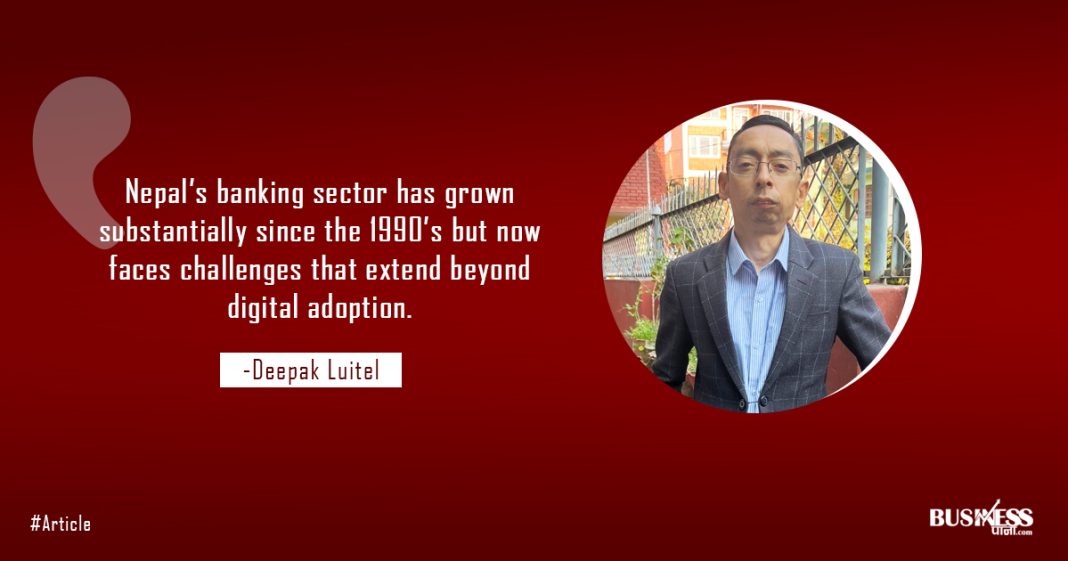

Author: Deepak Luitel
Past and Present of Banking sector
From simple beginnings, Nepal’s banking sector has evolved into a major lifeline of economic activities. Its evolution can be traced back to three distinct phases: circa of the 1990’s liberalization, open doors for private sector investment followed by expansion, and digital transformation. These phases of evolution have expanded financial access, improved operational efficiency, and innovation of new products. Today, however, the sector confronts new challenges- rising non-performing loan (NPLs), slowing credit demand, mounting asset quality risks, growing digital data and data vulnerabilities, even as it continues to adapt to the trends of digital finance.
Table 1: BFI’s Then-and now
| Categories | 2010 | 2025 |
| A | 32 | 20 |
| B | 83 | 17 |
| C | 79 | 17 |
| D | 18 | 52 |
Sources: Nepal Rastra Bank monthly statistics
Over the span of 1.5 decades, the number of banks and financial institutions (BFI’s) has trimmed down from 212 in 2012 to 106 in 2025, reflecting a regulatory push for consolidation and strengthening financial stability. The changes in the reform have reinforced strong capital base, enhanced operational efficiency, and signaled that Nepal’s financial system is becoming sounder and more resilient.
Likewise, over the past 1.5 decades, the balance sheet size of the banking sector has expanded more than tenth fold, alongside a near doubling of branch outreach from 2,832 to 6,522 branches. During the same period, Nepal’s GDP size expanded at a CAGR of 6.85%, raising from NPR 1,245.7 billion to NPR 6,197.2 billion, indicating the role of financial institutions serve as the backbone of the economy and channeling saving into productive investment. However, this rapid expansion has also brought unique challenges, such as surge in non-banking assets (NBA), weak governance, low revenue margin, cybersecurity threats and policy uncertainty, all of which create ripple effect across broader economy.
Though Nepal’s financial sector appears stable in official data, recent trends suggest that financial sector is facing governance-related vulnerabilities beneath the surface. The sector has been instrumental in driving Nepal’s economic progress since the establishment of the country’s first bank, Nepal Bank in 1937. The 1990’s marked a major shift, rapid growth in the number of institutions, economic scale, access, and affordability of the services. However, this fast-paced expansion often came at the cost of governance and financial prudence. The sector’s focus on numerical growth overshadowed sound credit appraisal and risk management. By 2010, the number of BFI’s had expanded far beyond what the size of the economy and population could justify, exposing deeper structural flaws. In response, the central bank deliberately introduced consolidation policies and regulatory directives. Yet short-sighted decisions and persistent supervisory shortcomings have continued to exacerbate the sector’s underlying challenges.
Nepali Bank learns from Global crisis
Throughout history, global financial crises have reshaped economies, with the 2008 financial crisis emerging as a defining turning point. The collapse of Lehman brothers’-then a158-year-old leading investment bank symbolized the downfall of major financial giants falling to their knees, exposing the fragility of global finance. For Nepal, the crisis served as a crucial lesson in financial prudence, particularly risks of excessive concentration in lending portfolio. For instance, in FY 2010/11, commercial banks had an average exposure of 35% to 40% to the real estate sector (including housing loans), leading to liquidity pressures and market instability. This vulnerability pushed central bank intervention to stricter exposure limits and tighter supervision.
Moreover, this episode reinforced the critical role of central bank ongoing mandate to prioritize sound risk management frameworks, prudent credit assessment, and timely policy action not only during the period of crisis but as continued efforts to safeguard for financial stability.
Key Emerging Challenges
Nepal aims for a steady growth rate of 6% to 7%, yet even sustaining 4% to 5% requires political stability, low inflation, cheap borrowing, and a vibrant business environment. Within this context, banking sector is one of the major pillars of the economy, is facing some of the toughest challenges in its history and now stands at a critical crossroads. The recent observations reveal that promoters are gradually exiting amid rising NPLs, weak credit demand, declining profitability, and frequent policy shifts. At the same time, sector is often lack of skill manpower in areas of like business intelligence and risk management. These challenges have pushed banks to rethink strategies towards stability and long-term resilience. Thus, there are other emerging challenges that are growing and pose significant hurdles. These emerging issues include leadership quality, board of directors (BOD) effectiveness, conflict of interest, and the accelerating shift toward digitalization.
Leadership quality
Over the decade, Nepal’s banking sector has undergone significant transformation driven by digital adoption, operational efficiency, and more strict regulation. Yet, the playing field continues to be vibrant and complex. The role of the CEO’s has become more demanding than ever by balancing stability with innovation, building quality portfolios, leverage data-driven insights to enhance efficiency, and exercise situational leadership in critical decisions. A key emerging challenge is channeling excess liquidity into productive economic activity while resolving rising non-performing assets (NPA), which threaten banking stability. The situation has forced the leaders of bank to rethink way of doing business in the lens of lending practice. Hence, still sector operates under prudent regulator framework aimed at upholding good governance and ethical banking.
Board of Directors
Under the Bank and Financial Institutions Act (BAFIA), the board of directors are mandated to uphold ethical governance, define strategic direction, and safeguard stakeholder interests. Likewise, effective oversight of CEO’s and conformity to regulatory compliance to maintain institutional integrity. Yet, in practice, bank boards tend to prefer short-term gain- particularly dividend payout rather than enact long-term sustainable growth. This short-sighted approach contrasts to global practices. Microsoft’s, for example, went public in 1986 but withheld dividend for 17 years, choosing strategic direction of reinvestment over immediate payouts. This patience rewards investors with a CAGR 48% in stock value reflecting how long-term vision and governance alignment can drive sustainable performance.
On the contrary, recent cases such as Karnali Development Bank and NICA Bank exposed weak governance and supervision lapses. NICA, once a fast-growing bank, faced a sharp downturn in major indicators raising serious ethical concerns to the board and management. Banks NPL ratio surged from 3.45% to 6.28%, while non-banking assets nearing NPR 5billion reflecting aggressive expansion, weak compliance, and ineffective board oversight.
The conflict of interest
A conflict of interest occurs when personal interests such as financial gain or influence compromise professional judgement and decision-making. This problem is global and is often seen in boardrooms. The key question of such conflict is deeply rooted or merely superficial. In many cases, agency conflicts rise related to ownership structure and influential promoters who may divert loans to their own businesses or pressure management to act in their interest.
There are few notable instances indicating that banks have engaged in interconnected lending practices over a decade. These include evergreening of credit, loan swapping among institutions, and the inflating collateral values to secure larger funds for unrelated ventures. Such practices have now shown a serious repercussion, raise the issue of asset quality, governance, and prone systematic threat in the stability of financial system.
To address these concerns, the proposed amendment to Bank and Financial Institutions Act (BAFIA) 2023 aims to separate the roles of bankers and promoters. It also proposes that individuals holding more than 1% shares in a bank or financial institution should not be allowed to borrow from the same institution, promoting stronger financial integrity and governance.
Digitalization
The latest phase of banking sector transformation is driven by digitalization. Transaction has increasingly shifted to mobile banking, internet banking, digital wallet, QR payment, and point of sale system (POS) by reducing reliance on traditional brick and mortar banking. This technological shift has redefined banking from manual to a faster, and self-service oriented model. Nepal now has nearly 90% access to digital financial services, marking important step towards a “Cashless Nepal”. Over the past five years, mobile banking payment has grown by CAGR 48.38%, and QR based transactions have increased at a CAGR 12.87%, reflecting rapid customer adoption, demand for faster, and more convenient service.
Globally, developed countries’ banks are using artificial intelligence (AI) to boost efficiency and faster data driven decisions. For Nepal, AI may represent next wave of disruptive change and opportunity to stay competitive. but also risks related to data privacy, cybersecurity, and inconsistent internet infrastructure. Effectively managing these emerging risks requires stronger regulatory oversight, skilled supervision, and forward-looking risk management to safeguard stability. For an example, 2016 when hackers tried to steal nearly $1billion of Bangladesh Bank account at Federal Reserve Bank of New York, show how technology driven vulnerabilities can undermine trust. After the incident, the governor of bank resigned amid criticism for failing to maintain basic cybersecurity protocols. Overall, this kind of incident could be learning lesson for Nepal, strengthening digital systems, cybersecurity defenses, and risk management frameworks is essential for Nepal’s secure transition to digital finance.
Conclusion
In a nutshell, Nepal’s banking sector has grown substantially since the 1990’s but now faces challenges that extend beyond digital adoption. Weak loan demand, soaring non-performing assets (NPAs), and low return on equity (ROE) have eroded profitability, and growth, call for strong inclusive boards and forward-looking management.
On the brighter side, digitalization is the future of banking, redefining customer experience and reshaping the culture of financial services at a low cost. Yet to fully leverage these opportunities, Nepal banking’s must build a sustainable fintech ecosystem to reinforce Nepal’s aspiration of becoming a $100 billion economy in the coming decade.
Disclaimer
The aforementioned information in this article is the writer’s own opinion. All the readers are advised to make investment decisions based on their study and analysis. Email: [email protected]
Short Profile
Passionate about seeking wisdom in investing and learning new skills. I have worked in Capital Markets in various capacities- as Portfolio Manager and Research Analyst.