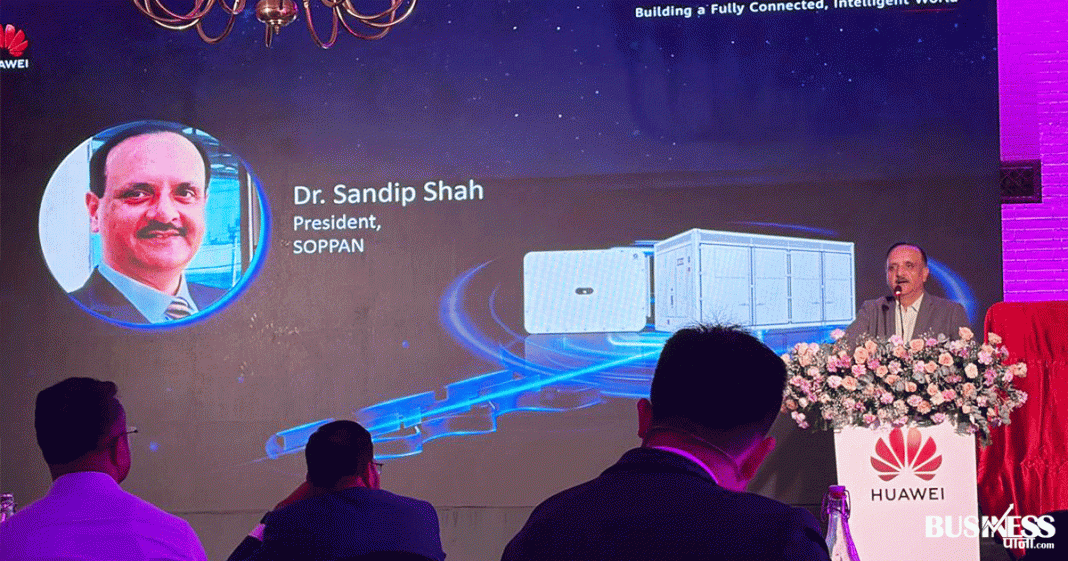
At the launch of Huawei’s latest utility scale solar inverter, the SUN2000 506KTL, the Solar Power Producers Association Nepal (SOPPAN) emphasized the urgency of aligning Nepal’s renewable energy policy with its ambitious national targets.
Nepal’s NDC 3.0 commits to 14,031 MW of renewable capacity by 2030, with government ambitions rising to 28,500–30,000 MW by 2035. Yet solar currently contributes only 155 MW. SOPPAN President Dr. Sandip Shah highlighted that hydropower remains Nepal’s backbone, but solar is the technology that provides flexibility, resilience, and daytime reliability.
Key Policy Asks from SOPPAN:
• Removal of the 10% barrier for renewables.
• Extension of generation licenses and PPAs to 50 years.
• Clear policy for license boundary amendments.
• Insurance premiums for property damage set below hydro’s ~0.15%.
• Announcement of the next auction for solar and BESS.
• Recognition that solar requires its own framework, not one borrowed from hydro.
Shah noted: “Technology is moving fast — Huawei’s launch proves it. Our responsibility is to ensure Nepal’s policy and infrastructure move at the same pace. SOPPAN will not rest until Nepal’s sunlight and ambition are fully turned into power.”
The Solar Power Producers Association Nepal (SOPPAN) is the national voice for grid connected solar power producers. Established to advance Nepal’s renewable energy transition, SOPPAN advocates for practical policies, supports project development, and promotes models that combine energy security with rural livelihoods. Its members are pioneering utility scale solar, agrivoltaic projects, and community inclusive approaches that align with Nepal’s Sustainable Development Goals.