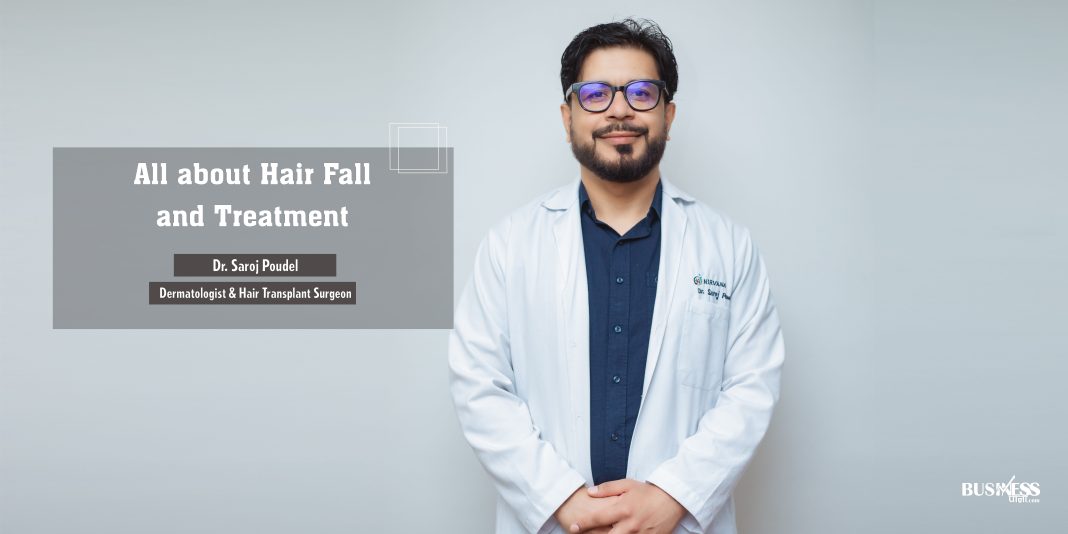

Dr Saroj Poudel
What is hair loss?
Most healthy people lose up to 50 to 100 strands of hair per day and is considered normal. As part of your hair’s growth cycle, new strands grow and replaces the lost hair. When you start to shed more strands and fewer or none grow back, the condition is considered alopecia (hair loss).
What are the types of hair loss?
The most common types of hair loss include:
- Androgenetic alopecia (Hereditary alopecia): This is the most common type of hair loss and can affect anyone. Males with this condition tend to lose hair from the temples and crown of the head while in female there is widening of central part.
- Alopecia areata: autoimmune disease
- Telogen effluvium: temporary hair loss caused by a stressor/change to your body. Eg: stress, sudden hormonal changes
- Anagen effluvium: due to certain medical treatments, such as chemotherapy.
What causes hair loss?
Hair loss has many possible causes. The most common include:
- Hereditary hair loss from genetics
- Fungal infections on the scalp.
- Hairstyles that pull hair tightly (braids, hair extensions or tight ponytails).
- Haircare that may cause damage (including bleach).
- Hormonal changes (such as pregnancy, childbirth or menopause).
- Medical treatment (such as chemotherapy and certain medications).
- Nutritional deficiencies (especially iron or protein).
- Stressful events (like surgery or losing a loved one).
- Thyroid disease.
How can I prevent hair loss?
You can’t prevent all types of hair loss, but you can take steps to help keep your hair healthy and minimize loss. To help prevent hair loss:
- eat a healthy diet that includes enough calories, proteins, vitamins and minerals.
- find ways to cope with stress.
- manage thyroid disease or other medical conditions that could result in hair loss.
- avoiding tight hairstyles
- using the lowest setting on a hair dryer
- limiting the use of curling irons, flat irons, or other heating processes that can damage the hair
- avoiding at-home coloring or chemical straightening products
- using lightweight shampoo and conditioner to
- using a leave-in conditioner to reduce tangles and breakage
- combing or brushing the hair gently
- during chemotherapy treatment, try a cooling cap
- avoiding smoking
Treatment
It is possible to treat androgenetic alopecia with minoxidil, a medication for hair growth. It typically takes about 6 to 12 months for hair growth to noticeably improve with this treatment.
Other potential treatments include:
- Finasteride/Dutasteride, a medication that treats male pattern baldness
- Spironolactone, a medication that may reduce female pattern baldness
- Laser therapy, which applies a low-level laser to the scalp to stimulate hair growth
- PRP (Platelet-rich plasma)/GFC (Growth Factor Concentrate), in which a doctor injects plasma containing growth factors from that person’s blood into their scalp
- Hair transplant
- Nutritional supplements
What is a hair transplant?
A hair transplant is a procedure in which a hair transplant surgeon moves hair to a bald area of the head from the back or side of the head. It typically occurs in the OT room under local anesthesia.
How was hair transplantation in the past and how is it now?
Hair transplantation is a cosmetic operation that has progressed with medical science and is backed by technology advancements. It wasn’t until Japanese doctors started in the 1930s that hair transplantation became a reality. But in the 1950s, American doctors developed cutting-edge methods with huge “Hair plugs” and later became more precise in 1970s and 1980s with development of “mini-grafts” and “micro-grafts” evolving to modern methods like FUE.
What happens during a hair transplant?
After thoroughly cleaning your scalp, a hair transplant surgeon uses a small needle to numb an area of your head with local anesthesia.
Main techniques used to obtain follicles for transplantation include:
- Follicular unit transplantation (FUT):
In FUT, the surgeon will use a scalpel to cut out a strip of scalp skin from the back of the head. The incision is typically several inches long. This is then closed with stitches after implantation.
- Follicular unit extraction (FUE):
In FUE, tiny punch incisions are made in the donor area at the back of head. Then surgeon makes tiny holes with a blade or needle in the recipient area of your scalp in which thousands of grafts are gently placed.
- DHT (Direct Hair Transplant):
DHT is the most advanced technique that involves extraction of hair follicle one by one from the safe donor area, located on the back of the scalp and implanting them immediately after extraction, improving the graft survival significantly, resulting in a better, faster, and denser growth.
Future trends and predictions
The future trends of hair transplant procedures show a lot of promise, with ongoing research and innovation in the field. Newer medical therapies and stem cell injections are being explored, with the aim of regenerating hair without the need for traditional transplants. Additionally, there are efforts to clone hair follicles, which could provide a means to grow new hair. Experts also predict that robotic devices will be able to perform extraction and implantation of grafts with minimal human involvement. Hair transplantation will continue to evolve.
Who might benefit from a hair transplant?
Receiving a hair transplant can improve your appearance and self-confidence. Good candidates for a hair transplant include:
- men with male pattern baldness
- women with thinning hair
- anyone who has lost some hair from a burn or scalp injury
Hair transplant isn’t a good option for:
- women with a widespread pattern of hair loss throughout the scalp
- people who don’t have enough “donor” hair
- people who form keloid scars after injury or surgery
- people whose hair loss is due to medication such as chemotherapy
Is a hair transplant painful?
The good news is, no — a hair transplant is not painful. At the time of the procedure, the area of your scalp that the surgeon will be focusing on will be numbed with a local anesthetic, so while you may feel a little pressure or movement sensations during the procedure, it shouldn’t be painful. Following surgery, you may experience discomfort or pain at the incision points for which pain medications are given for next 2-3 days.
What are the complications associated with a hair transplant?
Side effects from a hair transplant are usually minor and clear up within a few weeks. They can include:
- bleeding
- infection
- swelling of the scalp
- bruising around the eyes
- a crust that forms on the areas of the scalp where hair was removed or implanted
- numbness or lack of sensation on the treated areas of the scalp
- itching
- inflammation or infection of the hair follicles, which is known as folliculitis
- shock loss, or sudden but typically temporary loss of the transplanted hair
- unnatural-looking tufts of hair
What happens after a hair transplant?
Your scalp may be sore, and you may need to take medications following hair transplant surgery, such as:
- pain medication
- antibiotics to reduce your risk of infection
- anti-inflammatory medications to keep swelling down
Your surgeon will tell you how to look after your graft. You should be given a spray to use to help recovery and hair growth. You may need 1 to 2 weeks off work after having a hair transplant. You need to be very careful with your transplanted hair for the first 2 weeks after your operation. The grafts will not be secure. You may be told to cut down on exercise in the first month to reduce scarring.
- After 2 to 5 days: any bandages can usually be removed, but you should not touch the grafts.
- Day 6: you should be able to wash your hair gently by hand.
- After a few weeks: the transplanted hair will often fall out, and later start to grow back.
- After 4 months: new hair will usually start to appear.
- After 10 to 18 months: the full results should be seen.
What are the signs of Hair Transplants gone wrong?
Some signs that your hair transplant has gone wrong include:
- Poor growth of transplanted hair
- A weird-looking hairline
- Visible scars on the scalp
- Dead skin (called scalp necrosis)
- The incision wound opened up
Is it worth getting a hair transplant?
A hair transplant is a good option for people who can afford the high cost of the procedure and haven’t found success from treatments like minoxidil. Hair transplant surgery is relatively low risk compared with other surgeries.
How much a hair transplant costs?
A hair transplant in Nepal can cost anywhere between Rs 50,000 to Rs 2-3 lakh depending on the extent of hair loss, the type of procedure you have, and the quality of the clinic and its team. On an average, the price ranges from Rs 30 to Rs 100 per graft.
Things to consider before having hair transplant surgery
Before the operation, discuss the following range of medical issues with your doctor:
- physical health – an examination to decide if the treatment is appropriate
- medical history – some pre-existing conditions and surgery you have had in the past
- hair evaluation – includes your hair growth pattern, extent of hair loss, family history and any treatments
- risks and possible complications
- medication you take if any
- past reactions to medication or side effects, including anesthesia
- preparation for surgery
Why the choice of clinics is important in making hair transplants safe?
What makes a hair transplant safe to begin with is that the surgeon performing your surgery is qualified, and the facility in which the procedure is taking place is clean and safe. You may have heard stories of “hair transplant gone wrong” from people, but there are many factors that contribute to that, and the choice of the clinic is critical in that regard. Make sure to do your research. Be choosy and ask questions so that you know that you’re making the right choice.
How can I avoid these risks?
Fortunately, most hair transplant complications are avoidable with the right technique and care. So how can you make sure your hair transplant is safe?
- Choose qualified/experienced surgeon and a reputable clinic having excellent track record of successful hair transplants
- Choose a clinic in your home country and avoid cheap clinics as they might have compromise of safety standards and technical skill.
- Have an in-person consultation
- Follow your aftercare advice carefully
How to identify black market hair transplant clinics
Black market clinics are more likely to result in severe complications. Fortunately, there are a few telltale signs of black-market hair transplant clinics:
- Cost — Many black-market clinics cut costs by compromising on safety and skill.
- Registration with medical bodies — In Nepal, all clinics should have registered dermatologist with Nepal Medical Council who are eligible for performing hair transplant surgery to ensure they have high standards of care and safety.
- Hair transplant clinic reviews — Reputable clinics should have a large number of positive reviews from their patients. Look for impartial google reviews.
- Check Before and after hair transplant photos
- Named hair transplant surgeons on their website — Most black-market clinics won’t know who’s going to perform your surgery, so they don’t name a surgeon.
Hair Transplant in Nirvana Skin Clinic
Nirvana Skin Clinic & Hair Transplant Centre is known for providing the best hair transplant in Nepal, done by highly qualified & experienced hair surgeons. The transplantation results you will receive bear almost no pain & will be surprising. This is possible because of advanced techniques used at clinic. If you talk about hair transplantation cost in Nepal, you will get very reasonable costing at Nirvana Skin Clinic, Kathmandu. It is well equipped with latest lasers, aesthetic devices along with highly sophisticated OTs for hair transplant & cosmetic procedures. If you want to learn more about getting a hair transplant, book a free consultation at the Nirvana Skin Clinic and Hair Transplant Centre, Kathmandu.
(Originally published in the latest edition of Businesspana Quarterly Magazine)